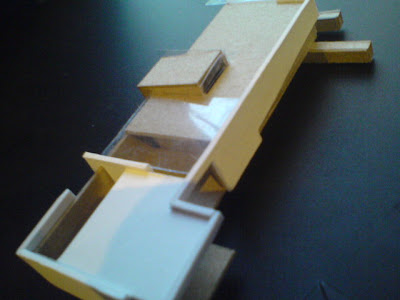
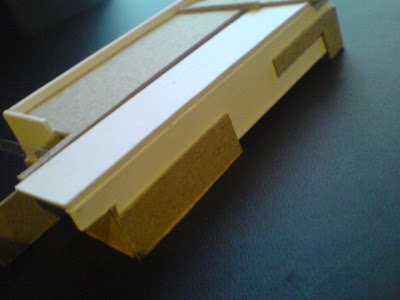
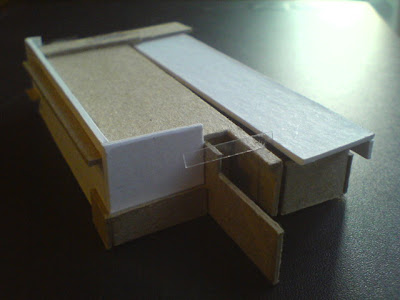


At this stage the design as a lot of symbolic features...perhaps more so than what is needed. The yarn wrapping over and around has only a symbolic use and does not read into the design well enough. Also the character does not have a real pressence in the design. It is just this and this and that, which which shows that...therefore a design process of the character's presence and her life's essence.
Ok so...trying an option of the yarn becomming more of the design and structure itself as a meaning of her life's essence becoming more than just a wrapping effect around the tower. Developing the design more concentrating on the essence of the yarn.

Here also showing the presence the yarn and its invading effect from inside the design within the bedroom unit.

Its Bold presence from being a symbolic image to become the essence of the design as a means to holding her life together

Now having being further developed from a feature to now starting to create more of a presence as her life's "structure". The design now needs further depth into this "structure" and presence as more the character and not an item.
Adjacent to this design thus far...a second variation shows at an early stage a similar early translation as being too symbolic but has more meaning into a phase of her life. Trying to represent the nature of her time within the orphanage.

Detailing through the entrance of the orphanage-like unit includes a further abstracted crochet resembled hook piercing through thus invading into her life early in her time at the orphanage. Similar to that of the first variation a yarn wrapping structure also invades the design.


Unit 7 this time is a voide represented as a tower through the external height and not identifiable from the outside (just like her life inside the orphanage as a 'nobody'). This void has no definitive means of access only that it is dark with a slit of natural light. Reminiscent of her life within the orphanage of her fear of darkenss and a single candle lit source of sight. This a major part of the interaction outside of her inner self and thus her point of reflection in the design-unit 7.

This design, like the first, will undergo further transformation and exploration into trying to achieve the main concepts of character presence and her life's essence.
...to be continued...
Okay...now going back to the sketchboard some basic exploration through darkness in her life and the linking together of her occupation and fears. Also exploring flow through the design...


Exploring flow and direction, wrapping. Also demonstrating darkness and its potential to invade her life.


Now with a clean grasp on a design through the essence of my characters fear of darkness, her presence has depth and meaning. also combining this thought with wrapping and layering of structures. A basic "crawl-through" corridoor of darkness is the central core of movement flowing through the design.

 Junctions wrapping around one another representing the wrapping of fibres within the yarn. The wrapping structures supporting the whole design and holding it together. the main structure sitting ontop of the dark core where the only source of light is at either end encouraging movement and essentially getting acustomed to darkness which is always under her.

 Having light penetrate the building through open feneatration and directed throughout the design. The light upper structure and dark under foundation of core movement.


 Finally showing distinct wrapping and trinsition of light and dark, heat and cold. The superior love and happiness of light stacked on lonely, gloomy darkness. A potential final variation.
...to be continued...
Moving from the first final variation similar features are used to furhter explore light-dark, heat-cold, as well as the flow of darkness and its ability to control her life. Continuing with the idea of the controled emotion of her life overcoming thus becoming superior to her fear of darkness. Being the under foundation of ther life hence the mains tructure containing the units. Unit 7 once again situates within the trench of darkness. This trench once again is waist deep and needs to be crawled through upon entering but then opens up into a tall narrow space with no light except form the entrances. this space inturdes upon her life but is concealed by the building structure.


 Expressing the detail of the light guided through the main structure of the design above the dark trench below. Similar to the design before this. A real presence or light-dark and heat-cold can be felt.
 Finally finishing with a design that combines thedark trench intruding into the centre of the house units but at the same time it is controled and concealed from the light. The only light is at the entrace through the trench, encouraging flow and direction through the design and overcome the fear for there is space and life where there is dark and fear. Throughout the design walls bend around one another and lock together supporting her life inside the building. Fenestration through panelled glass provides not only the light source but locks with walls and penetrates the dark trench providing interest. Another potential design to become a final variation. The model form of each design will now be attempted and explored further with strong intent to develop each solution even further.


Understanding the identity of "Riga"